Thursday, January 7, 2010

Chapter on Cold


Last night I was able to read author Greg Breinings' chapter on cold for our upcoming book,
"Paddle North."

Great timing!

Today we will be experiencing another arctic outbreak here in the upper midwest. Failing to address the issue of extreme cold in our neck of the woods would be a mistake when covering the BWCA. Breining has brought home the concept of cold in his words and descriptions. You'll enjoy his musings. Since I spend a great deal of my winter out in the wilderness cold, selecting images for this chapter will be a treat.

Some of my fondest winter moments seem to happen after a fresh snowfall. The reasons are obvious I think. There's a softness and calmness that comes with a fresh, cleansing snowfall.
Making fresh tracks in the snow make you feel like you are the first to leave your mark on winter. Observing tracks of wildlife, like fresh wolf tracks is exhilarating. A story seems to unfold right in front you. When were they here? What did they see? Were they chasing something? Or, just traveling by?

Getting a glance of a wolf is akin to a celebrity sighting. Its pretty rare and almost always memorable. In an earlier blog here, I had spotted a cluster of five wolf pups when my daughter, Austin and I were looking for Erik Simula completing the last leg of his epic journey last summer along the Grand Portage. Austin and I still talk about that thrilling moment in the woods.

Winter can warm your soul.

Monday, January 4, 2010

-38 F Below Zero


Winter has returned and with it those cold temps that seemed to elude us in past years. Those of you who reside in geographic locations outside of the upper Midwest will no doubt cringe at the thought of below zero temps. Of course, as a photographer, these weather situations offer visual opportunities unseen in warmer weather.

Ah, that feeling of fingers hurting so badly when the gloves had to come off to change the media card in the camera, or that sliver of wind cutting into your skin through that tiny little opening the wind found (and it finds it every time) in your jacket. Yeah, good times!

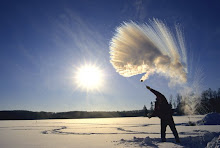
Amy Voytilla, a guide at Wintergreen Dogsled Lodge in Ely, Minnesota wrote of guiding her winter camping trips last week with temp.s hovering the minus -30's F. It reminded me of a magazine assignment I had a few years back where we were covering winter camping in Minnesota's Boundary Waters Canoe Area. That year too, was very cold and every day was in the Minus -30's. I snapped the photo below of polar explorer Paul Schurke, owner of Wintergreen, on a crisp morning. While making breakfast, tossing up a ladle of hot water from our oatmeal water, into the air hot water vaporizes instantly into powder. Now, you can't get that image on those warmer days like -5 minus F!! This is part of winter magic.

Such is life in the northern wilderness in winter. A chapter in our book will be dedicated to cold and those activities that transpire when canoes are put to bed for the winter. Motorized vehicles are not permitted in the BWCA in winter. So, the landscape of snow covered lakes are
etched with tracks of wildlife. Wolf tracks dot the lake, criss-crossing back and forth, perhaps in pursuit of a moose or deer, imprints of raptors softly detail wing patterns in soft snow, and deep shadows of black spruce covered in snow appear as bubbles in the snow cover. Dogsled teams break through deep snow and snowshoe tracks leave frozen fossils of their journey.

Winter can be a marvelous time to enjoy the Boundary Waters. Today is minus -26 F up North.
All I want to do is get out in it! And, of course, take a sauna when I come back in.....

Sunday, January 3, 2010

Thursday, December 31, 2009

The Visual Weave


Last week a good friend and exceptional writer, Jeff Rennicke, posted some new photographs he had taken of seagulls in his hometown of Bayfield, Wisconsin. The images were some of the best seagull images I've even seen. I know, you are thinking seagull photos? Well, Jeff had elevated a common subject to a new and exciting level. I wish I had one of those images here to share with you. I'll contact Jeff to see if I can't obtain one to post here later. But, I do have a comment that Jeff had written about his seagull images;

"One thing I love about photography is how it forces me to "re-look" at common things. Living in Bayfield, I've seen gulls probably every day for 20 years and they always seemed pretty common but my camera gives me a chance to "re-look" and see beyond my own ignorance."

Jeff has always had an interest in photography and has become quite an accomplished shooter.
That's a little scary for folks like myself since now he can photograph his own stories! As Jeff's vision has improved so has his excitement and motivation to carry his camera everywhere. I wrote back to Jeff responding to the quote on his posting with that photograph of seagulls;

"Hey Jeff, You've made that wonderful and important transition with your photography. The camera is no longer an instrument of recording. It has become an extension of your mind and soul. The path you take now needs to be a personal one absent of influence to reach that goal of developing a style. You are clearly on your way."

Its so exciting to see Jeff reach that level of developing a style. Photographing not only what he see's but what he feels. Like the strings on a guitar making music, his camera is now a vehicle for self expression.

So many beginning shooters are looking for the "pretty picture" and often times miss those simple details that can communicate a mood instantly right in front of them. Mark Twain's quote "You can't depend on your eyes if your imagination is out of focus" has always been a favorite. As visual communicators its our mission to examine the environment around us and make choices about what and how to photograph to communicate our thoughts to an audience. Different photographers choose assorted ways to express their visions. Some focus on the broad picture, others search inside the macro approach while others might simply seek quality of light to express their visions. One of the greatest photographers living today, William Albert Allard, comments about he likes to photograph on the edge of situations. I've always found this area to rich in material as well.

Creating images for this new book, tentatively titled "PADDLE NORTH-Canoeing Minnesota's Boundary Waters Canoe Area and Quetico Wilderness" its been my mission to create a series of moods and informational imagery surrounding text exploring various aspects of the BWCA wilderness. First goal; not to be repetitive in any of the images. This is a difficult task considering everything takes place on and around the water. But, its those little things that bring home the BWCA experience to the reader. Sitting at a portage resting and seeing a tiny clump of water grasses reflecting on the lake, muddy footprints on the portage, fabulous clouds
competing with the tops of radical Jackpines are all ingredients for a diverse examination of this wilderness. This tiny details are the BWCA experience. Not just the pretty sunrise and sunsets. In fact, I doubt you'll see one image like that in this book. I often tell participants in my photoworkshops that at sunrise and sunsets turn your back on the sun. That's where the great light lives! Yet, another example of photographing on the edges.

Jeff and I collaborated on a wonderful book several years ago detailing life in the Apostle Islands. The book, "Jewels On The Water-Lake Superior's Apostle Islands" is a definitive
look at the Apostles and island life. I've enclosed a photo of the cover here along with a
image or two from the book. Jeff's words bring to life the Lake Superior experience that is the Apostles. Its a good example to see that those little details and moods are such an integral part of photographic coverage on any project.

I'm thrilled to have worked on this book with Jeff. Especially now that his photography
has reached new plateaus. Heck, he'll be doing his own books now!

Lastly, there are moments in a photographers journey within a project that a particular moment just cries out with relevance. So much time photographing the area in all seasons, one would thing that a cover image would emerge. Yet for me, one had not surfaced. I've shot hundreds and hundreds of fine images, all strong in their respective form of communication, but not cover worthy. Then, on my last shoot of season, sitting at a portage off the Gunflint Trail, the ground was frozen, small puddles were already icing over, one of our paddling partners was preparing to load his canoe and head out across the lake. His boat was a beautiful birch bark canoe, he was stepping towards his vessel with gorgeous light bathing the side of such a classic canoe. It was a contrasty and low light scene. I grabbed my camera and instantly knew this was a cover. The combination of light, gear, the birch bark, the angle of the lens, all spoke volumes to me about the BWCA experience. It was that romance we all seek when we go there. Seeing this scence unfold in front me completed the project for me. In 1/30th of a second I felt I had captured both the history and mood that is the Boundary Waters Canoe Area. Now,
I need to convince others who were less receptive to the richness in this visual moment.

Ah, the beat goes on!


Monday, December 28, 2009

Winter's Beauty


There's no question that I really enjoy the winter season. I grew up in Alaska so winter is nothing new to me. In fact, I embrace the winter season and feel privileged to see a full four seasons here in Minnesota.

What is it about winter that stirs something deep inside us? For me, it's a number of tiny treasures that light the soul. I think at the top of the list would be the silence that comes with winter. Snowshoeing into the BWCA on a crisp February day you can stop and hear only your heartbeat. The insulation of the snow traps the normal sounds. There are no leaves, no waves,
and few voices. Its a real treat.

Second for me is the ice. I love ice. Perhaps its a photographic thing. That translucent quality and visual pleasure that ice brings to the eyes is mesmerizing. Assorted hues and colors dance while playing off the light. That gem like sheen and softness begged to be touched. I see a broken sheet of ice sticking on a lake or shore and I make tracks right to it.

And lastly, the primeval aspects of winter stir the mind in ways non-winter climates will never showcase. Winter camping in the BWCA touches the considerations of survival. Things like wind play a huge factor in many daily decisions. The thickness of lake ice, depth of snow, and carrying of gear all contribute to how a trip will be endured. Tackling a winter camping experience is rewarding and educational on so many levels.

It would be shame if a book on the BWCA excluded the frozen season. We decided early on that a chapter on winter will part of this BWCA/Quetico book experience. We'll be focusing on dogsledding as the vehicle to take us there. With that will come excitement, silence, and textures only winter can bring on. Here's a few examples. More winter discussions to follow soon.

Thursday, December 17, 2009

Fall Moves Into Winter


We experienced an unusually warm November this year. I had planned on photographing someone paddling in a snowstorm but the warm and usually snowy November produced little or no snow. Then, when we did get snow but it came at night. Dang!

Right after the snows, the arctic clipper arrived, ice formed and my chance was gone. This is the way of photography. You want to be everywhere for everything. Its just not reality. Sometimes one gets away.

One that didn't get away was capturing the art of netting Whitefish in the BWCA. A practice I did not know anyone still did. After some research I found that Erik Simula still nets. I hooked up with Erik and spent two nights in the BWCA photographing the process of netting. It was great to observe and the size of the whitefish was impressive. Erik had mentioned if he got 5-6 fish he'd be really happy. I had no idea what to expect. I felt 5-6 would be a bad day. Then, I saw the size of the fish and it all made sense. Many more and it would have been difficult to haul out!

Whitefish I'm told is a rather fatty fish thus is very good for smoking the fish. Erik uses the fish he nets for food over the course of the winter. As a photographer, I couldn't have been happier to see Erik using a traditional birch bark canoe for this. It simply made the images more romantic and captured the mood of days gone by.

Wednesday, October 14, 2009

"The Negative is the Score, the Print the Performance"


Isn't that a fabulous quote from photographer Ansel Adams? Adam's of course was revealing the process of creating a photograph. But, this wonderful thought is applicable to so many aspects in our busy lives. It is also an appropriate phrase for producing a book. I've been asked numerous times how a book like this is put together.

Wow, that's a loaded question.

There's a lot that goes into creating a book that is never seen. And, that's a good thing. Being on this side of the fence and seeing all that goes into the process of gathering materials, research, trips, camera, lens & digital costs, preproduction, postproduction, design, editing, ect. is overwhelming at times. All I can say is the price you pay for most books is truly a bargain.

Producing a book is akin to a musician creating an album. Think of all the musicians, song writers, sound engineers, promotion people, concerts, instruments, all combining to put out an album. And, when in the hands of dedicated people who love their respective jobs, a fine product is born. I feel this comfort and dedication with those I work with at Borealis Books, a publishing division of the Minnesota Historical Society Press.

For photographing a book on canoe country we are rapidly closing out the season for visual coverage as fall leaves continue to drop and snow has landed in the northern reaches of the State. I'm comfortable with the summer coverage but like most shooters I know, I wish I could be everywhere all the time. I feel I am always missing great images because I am not there when wonderful moments happen.

Its just the way it is. We can't be everywhere all the time.

So, we pick our spots and work within the economic timetable allowed. I try to peek under every stone and obtain visual coverage of everything I feel is significant whenever possible. The most frustrating part of creating images for a book like this is leaving the area knowing there will be be situations we want to experience and capture with our lenses. It stresses me to miss
opportunities.

Basically, all books begin with an idea. Writer Greg Breining and I have chatted about a book on canoe country for years. The same was true with our recent book on the culture on ice fishing, "A HARD WATER WORLD." There are lots of books on the how-to aspects of ice fishing. Greg and I were more interested in the cultural nature of the sport. Report on the wild and whacky, those dedicated folks who live in the boreal ring of ice and why do they do it. The book has been a wonderful success and we're using that same approach with this book on canoe country.

First, we look for publications on the subject of canoeing already out there. We needed to come up with an idea that was fresh and would not compete with existing titles. We've broken down the theme into chapters that will explore the myriad of life in canoe country. For example, we'll look at things like mood, history, seasons, and ecology. And, we've kept the effort close to home. This will be a regional book. Can you imagine the costs and time necessary for a book on canoeing with a national scope? You'd need to travel so many places spending what would seem like seconds in one area only to move on to another in order to finish all the locations where people love to paddle. Coverage would be thin and much lost in missing those experiences in such famed and historical areas like the Adirondacks, Arkansas, and Alaska to name a few. There's not a publisher out there who could afford to produce such a book. It makes more sense to stay regional. We are blessed in our region with the likes of the famed Boundary Waters Canoe Area (BWCA) and Quetico Provincial Park. The rich voyageur history and over a quarter million annual visitors make this area a compelling reason to do a book.

Coverage? Another loaded question. What do you cover when examining a region like this? One could take on any number of pursuits. It could be focused simply on plant life or fishing, old resorts, camping, wilderness, ect. A tremendous amount of time could be spent investigating all of these topics and each could actually prove to be a book all on its own. Our approach is an overview of personal experiences, usage, history and mood. It will blend a fine mix of informational and emotional themes.

Most books projects I've worked on there's been a strong connection with the writer and myself. We seek to have words and images form a marriage. We want different personalities and perspectives merging without repetition. We seek fresh insights coming from both words and images. This effort has been a bit different than others. I've not heard from writer Greg Breining all summer on what he's covering. This of course might make me a bit nervous since this is my key season for creating visuals. However, Greg and I have worked together enough on varied projects around the planet for two decades that we carry a sixth sense between us. Still, we are excited when we see each others work melt together to carry a topic to new heights. We still enjoy learning from each others work. And ultimately, this is our goal for readers.

I've still got some time left before the lakes freeze over and I plan on shooting addt'l images
during the seasonal transition. Rest assured we'll not forget winter. We'll have a chapter on dogsledding in this book too. After all, we use our frozen canoe country in very exciting and richly rewarding fashion too.

In the meantime, a glance back at a few treasures in canoe country.