Monday, March 25, 2013

You Never Know

Years ago I was watching a 60 MINUTES broadcast while overnighting at a hotel. The story they were covering was about a bright young man who had grown up in Harlem, became successful, and now was returning to his old neighborhood, buying old beat-up buildings and remodeling them into affordable and safe housing for people to move in to. It was a wonderful story.

As the TV crew followed him through the hallways, up the stairs, into an apartment to visit with one of the new tenants, I noticed the wall behind them had one of my photographs made into a poster. I jumped up looked closer, and sure enough, an old wolf image of mine made into a poster. I laughed out loud and shook my head with a big grin. Hey, I made 60 MINUTES..... and in a good way! HA.

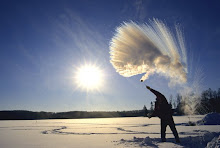
Sometimes you just never know why an image is gonna end up where it does. These little surprises are a nice treat. Its part of the fun in this business. Recently, during one of my winter photography workshops, a brutally cold morning gave us the perfect ammunition to create an image that you can only achieve in this sort of hostile environment.


It was -36º F Below Zero. When you toss up a ladle of hot water into this frigid air, that hot water instantly vaporizes. It makes for a wonderful images combining both science and art. It soon appeared in National Geographic's "Your Shot" collection of online images.

Another example of how unusual circumstances result in unexpected placement, came from a photograph I snapped while shooting a Smithsonian Magazine assignment. I was in North Dakota covering a feature story on a farmer who collects tractors. While crossing from one field to another across his land, I stumbled onto a sort of "old car graveyard." I spotted this 54' Ford Crown Victoria with an Ash tree growing right outta of the hood.

It struck me immediately, NATURE'S REVENGE.


I sent the image off to one of my favorite clients, Patagonia, and they soon used it on one of the cover of their clothing catalogs, then in their beautiful book, UNEXPECTED. Now, over a decade later, they are using it again as a design for one of T-Shirts.

How cool is that?  Ya just never know.

F/8 AND BE THERE.


Monday, March 18, 2013

Great Lessons In Photography

Why is it that the most significant lessons in life are always the toughest? It probably has to do with that age old concept "we learn more from our failures than our successes." I hate to say it, but it's true to the bone. Its akin to the You Can't Win If You Don't Enter theme.

Ya gotta be out there generating images and creating the most articulate ways to visually communicate. That instantaneous moment when content and art blend together is magical. It motivates one to continue aiming their lenses at the world.

In its roots, photography has always been a science driven medium. Indeed, it can be hard to see it that way, what with all the auto-this and auto-that available today. One barely needs to understand the science to get decent exposure. For the general public this is a monumental advancement. Scoot over to the most recent photo technological advancement, iPhone's, taking a photograph is amazingly simple, can be processed and shared world-wide within seconds.

My photography roots emerged from black & white photography. I was hooked on the medium the moment I witnessed a print emerging in a well seasoned tray of dektol. I studied the works of Edward Weston, Ansel Adams, Minor White, Paul Caponigro, Dorothy Lange, Wynn Bullock, and Margaret Bourke-White to name a few. One quickly learned, they embraced the science of photography. They knew what film and developer combination would produce a decent negative. Understanding the complexities of printing those negatives to show off the myriad of zones and tonal values to achieve an exquisite silver halide print defined the fine art photographer of that era. Science, all science.

Wow, times have changed and digital dominates the industry. Its still science, not as organic as the chemistry laden past, but driven by math, this technology takes such giant steps it can be difficult to keep up with the changes and the costs. But, grasping digital technology and understanding its capabilities continues to be the edge photographers need to pull the most out of the visual situations they face in field.

In a recent workshop, a participant was drawn to a very contrasty scene. She looked at it, made her composition, and snapped the shutter. As she walked away from it I heard her say, "that'll never work. I'll lose all detail in those shadows." She looked at her camera monitor and sure enough it was contrasty. But, not all is lost. I explained to her, the beauty of digital is dark areas are digitals' playground.

That said, I wanted to show everyone a quick and easy way to pull out those dark, contrasty areas out of your digital captures. As many of you know, I tend to stay away from the techno lessons because I'm more concerned with people learning to see visually. But, part of learning to see is not walking away from compelling situations because you worry they just worn't work. Chances are damn good in today's digital world what you see in your mind can be accomplished photographically.

Let's take a look at this image below. While teaching in Cambodia on a Mentor Series Worldwide Treks (http://www.mentorseries.com/) we were photographing a small village with several temples and a small monk monastery. I spotted this young girl leaning on a railing. She appeared unhappy and very preoccupied. I heard sounds of chanting and music coming from the area immediately to her right. Curiosity begged for a more defined reason why she was not engaged in the music. As I moved closer, I could see the monks, all men, holding service. She was not allowed. I wanted to capture her mood and yet also include within the frame the source of her discontent.

But, as you can see it's an exposure problem. There's probably four f/stops in difference between her face and the dark room where the monks are holding service. While my eyes can accurately witness the scenario, it's a photographic nightmare of extreme exposure differences. Yet, for this to be a good photograph, it needs all the information in the scene. Not to worry!

Click on the images to enlarge

Proper exposure made on young girl creates severe darkness to the right
Using the Adjustment Brush tool in Photoshop or Lightroom
as a mask, we can bring up the dark areas

Wow, is it that simple?

Yes, it's that simple to bring back the image as observed on site. You won't lose the valuable editorial content necessary to understanding the moment that was hidden in the dark areas to the right.

If you are a Photoshop or Lightroom user and have not used this tool, learn to do it. It will save numerous images in your files and provide the confidence when out shooting that tough situations can be brought to life right out of your RAW files. Chances are darn good the information is there. You just need to learn how to bring it out.

This is an over simplified peek at this technique. But, one you will love if you have not used it in the past. All those images you were so worried about.... go back and give em' life. Science is a tool!

When opening RAW Files, choose the Adjustment Brush Tool, seen on top. Then, I like to check
the SHOW MASK box at the bottom, so I can see what areas I'm masking.
Here, you can see the masked areas I brushed on the right side. Once brushed, I turn off the
SHOW MASK (the fog disappears but is still there) and move up to the Exposure slider and move to
the right if I want it brighter, and magically watch the masked area come back to life. I have complete
control of how much I want it to brighten.
The finished image! You have great control over how you do this, the amount, the feathering, ect.
And, when you like what you see, when going to OPEN IMAGE, use OPTION-CLICK on
the open-image button to open without updating image metadata keeping your original
RAW file just as you had originally exposed it.

Here's another example; A beautiful blue door inside a historic farmhouse in Iceland caught my eye. I loved the color and the wonderful composition of little patches colors and lines criss-crossing about the scene. But, I also wanted more detail in some of the dark shadow areas to give the viewer more information in the room. Using the Adjustment Brush, it let me lighten those hidden areas.

Here, you can see the areas I decided to utilize the Adjustment Brush and mask
the areas I planned on boosting up the exposure to resemble a look more like my
eye had seen inside this room.
A comparison with the before and after

Tuesday, March 12, 2013

There's Still Hope for Photographers-Good Luck-Good Light story in the NY TIMES

With all the bad news, like this Hire A Photographer for $10 crap, its good to see something good happening in the photography world once in a while.

Check out the link below to read more about GOOD LUCK-GOOD LIGHT. If it does not take you there directly, copy and paste the link.


And, this sort of thing (below) might become the norm for some, but rest assured it will eventually kill the photography business as we know it today. I'm not sure how it will affect the editorial world, but most photography eventually finds its pricing methods in editorial. All I can suggest, is don't be stupid and go for this sort of thing.


Its important that you understand the value of your work if you intend to stay in to make a living. If someone wants to offer someone $10 to shoot a assignment, let them use their own iPhone and post the images themselves. Even that work, which will take valuable time, will cost more than $10.

Thursday, February 7, 2013

COLD REMEDY

Those people intimately familiar with winter, know that your nose will run like crazy out in the cold. It comes with the territory. That's why long sleeves were invented. Its also a great opportunity to capture images that many shooters miss.

Hot water vaporizes on minus -26º F morning near Ely, Minnesota
(CLICK ON IMAGES TO ENLARGE)
Its not easy shooting in winter. Trudging through deep snow is tough physical work. A mental mindset also needs to exist. Warding off the pain in your fingers when trying to change settings can tax even the experienced winterized photog. A different set of equipment is necessary to get places. Snowshoes, dog teams, snowmobiles, cross-country skis are all options. But getting to places to where only critter tracks
mark the snow, the velvety cotton landscape comes alive with a different kind of silence. Mainly, there's just less people out there.

Consider the iconic photographic destinations, like our national monuments and national parks. If you visit these places in spring, summer or fall, those classic photographic gems are often jammed with people. Everywhere in your frame is a person, tripod or goofy hat. They are shooting the location, each other, others shooting each other, and so on. Its almost impossible to obtain a clean shot. The super-duper secret to getting that shot? You can lessen the distractions by going in the cold months. And, the bonus? Obtain images and an experience that few others care to tackle. It sets your work apart and presents a new and fresh perspective.

I plan several annual winter outings for shooting. One is a dogsledding adventure photoworkshop I teach at WINTERGREEN DOGSLED LODGE in Ely, Minnesota. We just wrapped up our 21st year and experienced quite the temperature swing. We started at 33º F and ended with minus -36º F. Its the best of two worlds really. We spend our days out in the wilderness mushing and our evenings in a cozy lodge with food prepared by a wonderful French Chef, Bernard Herman.

Wintergreen's French Chef Bernard Herman
Dogsled teams gliding across frozen lakes on the edges
of N.E. Minnesota wilderness
Don't let the temperature swing concern you. Its not normal. But, there are opportunities on both sides of the mercury to photograph. On those warmer, often overcast days, when a weather system is moving in trapping the mild air, the light is more often evenly lit. When high pressure moves in, it shoves out that cozy temperature and replaces it with biting, gin clear air where even the slightest breeze creates a wind chill that cuts you like a razor. And, with that bright light comes extreme contrast. You have to choose your battles. Even in the contrast however, a silhouette can speak volumes. Use what you have. It is what it is.

Harvesting ice blocks from a frozen lake.
Harsh light allows room for experimenting.
Overcast skies provided the perfect light source that brought to life
this frozen rock wall covered in frost crystals and ice formations.
Remember the key to a good winter experience is being prepared for the cold. Not only for your equipment, but you. Dress in layers. Stay away from fabrics like cotton. There's an old saying in winter
locations; "Cotton Kills."  If you get wet, cotton holds the water next to your body yanking the warmth right outta your skin. Synthetic clothing, like fleece wicks the moisture away keeping you insulated and  warm. Wool does the same.

When active, like dogsledding, I wear a pair fleece thin long-johns on top and bottom along with a good windshell. This keeps the heat in and the wind out. If I get chilled, I'll pull on another layer of thicker pile fleece or down, and pull over the wind shell. I can't stress how important the wind shell layers are. The key to comfort in winter is this; if you start to overheat, drop a layer. When you get chilled, put on another layer. Keeping dry is essential. If you are traveling over sea ice or frozen lakes, its a good idea to carry extra clothing just in case you flop into the drink. A good hat, balaclava and neck gator offer protection. If you are in windy conditions, use your ski goggles. They'll make you life like a day at the beach. Lastly, have thick mittens on hand. The kind that have a wind shell on them. Gloves only protect individual fingers and in really cold weather, you get cold fingers fast. When the fingers can work together keeping each other warm, the difference is remarkable. Light fleece gloves for shooting so you can feel the dials. Stay away from those fingerless gloves in winter. They're useless.
After your shot, pull the mittens back on.

Bad light can be great light for some subject matter in winter.
I knew B/W coverage here would set the ice apart from a scene already monochromatic.
Waiting for just the right moment when the ice block caught the backlight was essential to the images success.
For your equipment, if you are out all day in temps around zero degrees or colder, those little hand-warmer packets that keep working for 8-10 hours, are good to toss in your camera bag next to batteries, and your extra batteries. Just keeping the chill off them keeps them in smooth working order. Extra batteries in extreme cold is a must. And, remember when you return back to the vehicle or your lodge, after being out all day in the cold, don't expose your camera or lenses to the warm air. Condensation will carpet them instantly. Wet and digital electronics are not friends. They need to be kept away from each other. Keep your cameras inside the bag, wrap your coat around it and let it slowly come back to room temp to prevent the condensation.

Experimenting with visual options. This entire day felt like a walk back in time.
I used pixlr-o-matic app to help create an image that looks like it came
out of Grandpa's old shoebox.
I predict you'll find that being cold is just a myth. The sights and sounds winter offers are as unique as underwater photography. Not many do it, and those images waiting be captured are there for the taking.

And don't forget that ever handy iPhone. This little video was made using a app called Vintagio. Buckets of fun.

Safe journey's!


Tuesday, January 8, 2013

GHOSTS OF ISLE ROYALE


One thing is etched in stone. The first day for out of town assignments is the most stressful for photographers. You can't wait to dive into the work, make contacts, capture moments, feel that twitch you gain with new visual discoveries. Reality?  The thrill is tempered with all the cab rides, ferry's, permits, weather, ect.  It tortures the eager shooter. Its the game we play

This of course, is magnified when venturing out on a wilderness assignment. What you carry are the tools you'll have to complete the job.You are limited in your choices, to specific equipment. There's no turning back for more. Hard choices are made and you live with those decisions.

Even more aggravating, the unexpected. What you came to photograph seemingly vanishes from the landscape. Where did it go? What are we missing that nature is trying to communicate?


Day three into a six day assignment on Isle Royale brought storms and a complete absence of all wildlife. It felt spooky. "It had to be the storms," I said to myself. The wildlife has taken shelter in the forest. The forecast showed improvement in the weather in the upcoming days, but we were running out of time. We came here to photograph moose. Yet, there was no sign of them anywhere.

Calf Moose on Isle Royale from previous assignment
I've traveled to Isle Royale National Park numerous times over the years on assignment. A marvelous place, its isolated island ecosystem cherished by wildlife researchers. Initially, I became fascinated with the forty-five mile long island in Lake Superior while covering stories on wolves in Minnesota. Isle Royale had become well known for its wolf related history and I had become very familiar with the island.

Rolf Peterson, the famed wildlife biologist studying the unique closed ecosystem of Isle Royale, had taken incredible photos of the predator-prey relationship between wolves and moose. His images of wolf packs surrounding a moose from his research airplane just tickled my fancy. And then, I had seen Mitch Kezar's incredible photograph of a moose browsing for National Geographic and that further stimulated my interest in the long Lake Superior rock.

For years I had told writer Gus Axelson about the abundance of moose at Windigo. "We need to do a moose story here," I frequently bounced off Gus. Every Fall on the western end of the island the moose congregate for the rut. You couldn't hike anywhere without a moose sighting. Each and every one of my trips, moose, moose and more moose. If you want to do a story on moose, head to Isle Royale in the Fall and camp near Windigo. The four-legged men and women gather there.

(Left, moose blocking hiker along the trail near Windigo)
The Lake Superior storm brewing was big enough that N.P. staff were going tent to tent and hut to hut informing people that there would be no Ferry Service for several days. If they wanted to leave, they had 30 minutes to pack and get on the Ferry. Fall storms on Lake Superior are not something to take lightly. The shoals and reefs around Isle Royale have gutted many a vessel over the years and are testament to the violent wrath Lake Superior can bring.

We weren't leaving and plans were made. An eight mile RT hike would bring us to an exposed face of the island to view storm first hand. I love shooting storms. The risk can be worth the effort. I had packed proper rain gear and a watertight backpack for my cameras. Trails were open. Although, upon arrival, we were greeted by the NPS with cautionary advice about the horny moose and some trails will be littered with large debris from a earlier storm. Just be alert and careful was the advice.

(Right, dock at Windigo with Ranger Talk after disembarking)

So, we headed out. The chance for spotting a moose and snapping the shutter seemed promising. Eight miles is a lot of ground to cover and hiking past a variety of terrain put the odds in our favor. I've never been skunked locating moose on Isle Royale. And, the storms could add a new twist to a familiar subject. I was pumped for sure.

Then, the unexpected.

Its useful to combine knowledge and instincts in the wild. Storms can wreak havoc on the unprepared. Only experience can tranquilize necessary tasks in the wilderness. I felt the need to split off from Gus and friend Mike Kooi. I wanted to set my own pace, listen the way a photographer needs to hear and observe. I would meet them back at camp. Then, the wind and rain began pelting the island. My moose radar jumped to high. The wind was snapping off tree tops and with every crack, I whipped around concerned a moose was gunning for me. I often laughed at myself being startled so many times.

Stress seemed to follow every step. The audio level of high speed rain slapping my hood was deafening.  I couldn't hear anything in the forest. My pace slowed to a crawl. I would stop every 50 yards and take a 360º spin to look around. Dang, if a bull moose didn't try to make a date with me, surely a tree falling would take me out. The woods were outta control and the tree tops whipping like grasses. It was strange. It was exciting and eery all at the same time.

 I made it back to camp. Mike, Gus and I flopped down inside the shelters and the Windigo camp and cooked dinner. While we prefer tents, these shelters were a luxury we refused to pass up.

"Where is all the wildlife, I asked?"

It was freaky. No moose or trace of them, no birds, not even red fox. And red fox are everywhere on Isle Royale. You felt their absence. What message of nature were we missing?

I'm used to seeing so many red fox you have to be careful about leaving anything unattended in camp. They simply steal it and add to their collection. I'm guessing their den resembles a flea market.

(Left: red fox peeks in shelter at Windigo campground on an earlier trip)

By day four we needed to alter our plans. The search for moose, any moose was kicked into high gear. We had no story yet. There were virtually no campers left. No one to check in with to inquire about any sightings. Where can we find them? The last ferry off the island was in a few days and the National Park Service shuts down Isle Royale for the season. Its now or never.

Feldtmann Lake was about 9 miles away and there had been wolf sightings in that area. We put two and two together and figured where there's wolves, there's moose. We packed up and boogied out.

Antlers along Feldtmann Lake Trail
We arrived at Feldtmann Lake camp at dusk and were met with encouragement along the trail. Twice, we came across discarded antlers. Moose!

The trail felt warm. Even birds began to appear. The moose had simply parked somewhere else and with luck, we'd find them. Perhaps our luck was changing?

Again, we met the unexpected.


Feldtmann Lake with Milky Way and Aurora Borealis

We made camp just off the trail that runs along the North shore of Feldtmann Lake. Darkness comes early in Fall. The new moon sky quickly blanketed the forest in blackness. Gus, Mike and I felt the chill of the night, ate some supper, grabbed the headlamps and ventured from camp down across the trail to the lake. You could feel the solitude. No one around, park closing for winter in two days. Its all ours.

It was so dark, so black, the stars took on a movie like appearance. The Milky Way cluster was so obvious in the sky. I had not seen that in a long time. Even the Aurora was dim on the horizon welcoming us. Damn, if our luck hadn't changed. This was promising on so many levels.

In the photograph above, it was much darker than it appears in this image. My friend, the gifted photographer Richard Hamilton Smith once referred to darkness as "digital's playground." The sensitivity of the digital sensor far exceeds the capability of the human eye. Using high ISO settings, even a subtle aurora shows up on the back of the camera alerting us to its presence. You can do so much more with digital in low light than one could in the days of film.

The three of us sat there on a beached log in front of a lake. The lake was like glass. It was so still. The sounds of summer bugs and mosquitos absent. It was so quiet you could almost hear the stars etching the sky. We heard a voice bouncing off the lake from the other side of the remote campground. It surprised us. Who else is crazy enough to be out here? The park is closing in two days and its a good hike to get outta here. Must be some hard cores getting in one last camp for the season.

Down at the lake, I was snapping thirty second exposures, one minute exposures, and several minute exposures of the brilliant evening stars. The brighter stars were reflecting on the surface of Feldtmann. It was an amazing sight. Once our eyes adjusted, I could see reeds off shore to our left and darting satellites gliding across the sky like ice skaters. There's something extreme quietness. Its almost loud its so quiet. We whispered as if we were afraid to disturb it. Suddenly, we heard a splash. A fish? It was loud enough that I put the radar back on high in case it wasn't a northern pike taking down a swimming frog. We heard it again. Something was in the lake.

We became motionless, forcing more quiet on our log bench. A loud exhaling breath broke the silence, then another. Water was splashing, between breaths. A MOOSE! A dad-burn moose was swimming across the lake and we couldn't see it! Not even a glimpse. The night was just too black. Yet, in our minds, each of us could see the moose swimming. Its nose and massive head just above the surface, pushing water, creating its own wake with each deep breath as it swam. This went on for twenty minutes. Our ears brought the visual to life as we listened to the moose come ashore across the lake, shake off, and move into the forest. Soon, the bellowing and grunting commenced. A bull looking for love across the lake. We could hear branches crackling, his movement. But not see a thing.

Then, the unexpected. Again.

We giggled at the thought of a Wildlife Bar scene across the lake. The bull moose looking for a date, the cow playing hard to get and so on. Then, in the blackness of night, a dog bark. But, it came from the opposite direction of the other campers. 

"Who in their right mind would be stumbling into camp this late at night, I asked Gus and Mike?"

This was not a difficult trail, but in darkness it could be dangerous one. With game trails diverting you off trail, steep slopes, rocky ledges, we were surprised to hear anything. But, the dog barking confirmed someone had to be coming in, right? Nothing. No footsteps. No dog barking. No moose. No people?

The cold broke our curiosity and off we went to crawl into warm sleeping bags for the night.

Lake Superior overlook on Feldtmann Lake Trail

Morning comes early for photographers and I'm thrilled Gus is an early riser too. He appreciates the value of crisp mornings, that silence before life stumbles from its cozy quarters. I wanted to catch the morning fog hovering over Feldtmann Lake. This is a normal occurrence in the Fall when air temps drop below water temperature creating a thick blanket of fog over the surface until it burns off with the warming sun. For that first hour of sunrise a shooter can be gifted some remarkable light to play with. 

We beat the sun by a good hour. Mike brewed some coffee and we made our way down to the lake. I noticed once we departed the canopy of the dark forest surrounding camp, we gained a full two stops of light near the lake. It was still dark but not so much a headlamp was required to get around.

It was cold. The ground was frosty and the lake covered with fog.

Frost covered trail

When the sunrise hit the lake across from us, I expected the glow to be stunning. Gus and Mike brought their sleeping bags down to waters edge and wrapped themselves in warmth. I had the Nikon on the tripod and waited for the sunrise. Again, from the left of us, a slight barking sounds erupted. 
A soft whimper.

"Hey guys, that dog from last night is back, I stated."

I moved away from the tripod backing out towards the trail intersection that lead back to camp. It was perhaps five yards to the trail up from the lakeshore through the tall grasses. I peered right towards the direction of the sound.......and a lone wolf was standing there, staring at me. It was all clear now. In the darkness last night, it wasn't a dog with hikers, it was a Wolf!

I called over to Gus and Mike, "guys, there's a wolf right there!" 

They leaped to their feet only to see it bolt off. We could hear it whimper again in the short distance through the birch. I whimpered back. The wolf ran off along the trail that circles around the backside of our camp. My camera still on tripod, I took it off and quickly tiptoed my way back to camp with hopes I might spot the wolf again through the forest. It was still too dark to make a good photograph in the woods. The light was flat, dark and everything kinda blended together in similar hues and tones. But, what choice do I have? I wanted to get another glance of the wolf.

I heard the whimper and a short bark once again. I responded. Within seconds, now from the left, a wolf walks into camp, not ten yards away from me. Was it the same wolf? Damn, if it was, how'd he get over there so fast and come in from this direction? I stood motionless, my camera down by my waist, not wanting to flinch, worried the wolf would spook. As I began to raise the lens, boom. It was gone. I missed the shot. The wolf was gone so fast.

He slunk'd down as he bolted from camp, muddy from its toes midway up his body. Gus and Mike inched into camp. We could hardly believe our eyes. We were so thrilled, adrenaline pumping. I wanted to position myself to get a good shot. Damn, I still need more light!

I put the camera back on the tripod, boosted the ISO and aimed the 80-200mm lens down the trail to the right again. Odds were, if the wolf was gonna investigate us again, it might come down the trail. Its the easiest route for the wolf and the most obvious one. Well, for a human that is. My eyes and lens focused on the curve in the trail about 2o yards away. If the wolf shows, I'd get a frame off this time. 

Within seconds, Gus and Mike are franticly waving their arms and hands pointing to the trail leading behind me. I wheel around and there's another wolf coming right at me. Hands on the tripod, eyes on the wolf, he gets within 20 feet and slips away into the thick brush towards the lake. I was shocked. Not shocked at the wolf coming at me, but where it exited the trail. Any human would have been forced to turn around or push forward down the trail. The wolf, a master of its environment disappears into the brush like a ghost. People just don't think that way. The speed and grace in which he disappeared into that thick underbrush left an impression on me. I learned something in that moment.

I ran to the trail leading to the lake. The same place we listened to the moose swimming at night. I  hoped I might get to snap off a frame as he runs along the shoreline. The distance from the lake to the main trail is only about 10 yards. I reached the intersection to the small path carved through the grasses leading to the lake. The small opening through the grasses allows a peek at the lake and part of the shoreline. Then, in a flash, a moment that stands still, the wolf runs by in full trot, turning his head towards me, framed through the grasses like a painting. A millisecond that lasted for hours in my head. It was the prefect shot. Camera in hand running to the lake.....And dog gone it, I missed it. 
I'm comfortable knowing there was little or nothing I could do. I was still caught in pursuit.

Wolf runs along Feldtmann Lake shoreline

As the wolf rounded the shoreline, I was able to fire off a few clicks of the shutter. But, for a photographer, a shot of his backside doesn't make for significant images. The reflection of missing two  momentous frames already imposing pain over me, it was over with. The entire sequence of events consumed at best, several minutes. 

If a wolf whimpers in the forest and there's no one there to hear it, does it make a sound?  YES!

These incidents happen to photographers, writers, outdoorsman. Experiencing these precious moments of nature at large was an exhilarating thrill. We determined that all the action was created when we rose from the tent the pack of three wolves got separated. Two were on one side of camp, and the other one on the other side. We were uncertain obstacles inbetween. Curiosity forced a conclusion. At no point were we ever threatened or in fear. We were in awe. The process of interacting with a wild animal who thinks cannot be underestimated in the value it brings to the human experience.

A closing note: The wolf pack we had seen might have included the last breeding female on Isle Royale. Wolves traveled across ice to the wilderness island in the 1950's and are now in danger, through inbreeding and decline of breeding females to becoming extinct on Isle Royale. Population numbers took a serious hit two summers ago with several members of a breeding pack were found dead in the bottom of a mining pit, probably victims of falling in during winter. 

Many questions remain about the wolves of Isle Royale. Their presence stabilized a moose population expanding out of control. Global warming has prevented Lake Superior from freezing over in recent years thwarting any possible natural reintroduction.

Monday, December 31, 2012

SIX SHOTS-The Making of Six Photographs


One question that never loses momentum in photography workshops "what were your settings?" Folks always want to know the camera settings. This question has always amazed me. Its not the settings that made the photograph, it was the photographer.


(Click on images to enlarge)

Has today's photography become too automated? Has its simplicity stymied people into less creative decissions? People adjust the dials to AUTO and cross their fingers their vision will be enough to make a great photograph. Yes, it can happen. But remember to fulfill your vision the odds increase substantially when one knows how to use their instrument. Experienced photographers instinctively select settings on their cameras to create the visual music they hear in their head. They don't shoot by chance, but utilize a methodology choosing particular apertures and shutter speeds to achieve a pre-visualized goal.

I guess I've never paid much attention to the settings after the shutter has been released because all those choices were made prior to capturing the moment. Choices were deliberate. In fact, I cannot recall the last time I simply fired off frames not knowing what the settings were. Yet, virtually every popular photo magazine on the planet lists the meta data for every image it features. So, certainly there is interest in this information. I think the better question is "why those settings?"

Do music lovers walk up to a musician and ask, "Why that cord progression?" Musicians play notes to create a song, take the listener someplace that evokes emotion, a beat we tap our foot to, a melody pleasing to the ears.  Making a photograph is no different. Photographers have something to say in their captured moments. The settings that they choose are not accidental. They are purposeful akin to the musician choosing a note to string along a melody.

If you picked any photograph I made twenty years ago, back in the days of Kodachrome and Plus-X, long before meta data was saved with each and every image taken, and asked what my settings were.....I could probably tell you..... and be dead on. Its not because I have a great memory. Its that I  recall how I wanted to interpret that situation. I understood that a shallow depth of field was necessary to drop out the background and let my subject pop, or that 1/15th of second gave just the right amount of movement to sell the visual point desired.

Asking "what were your settings" is a good thing. Interested shooters are looking for answers and understanding the process and results teaches how to communicate more effectively. Keep asking those questions. I want nothing more than to see that grin across your mug when you nail it. As I venture into video with the Nikon D800, I find myself constantly looking at Hollywood film productions and asking myself, "how'd they do that." Being inquisitive sparks action.

In this post are six photographs randomly selected from my files. Let's run through the process of making these images. Don't be alarmed at the clanking sounds. Its just the ideas bouncing around inside my head searching for a way out.

SPRING VALLEY CAVE, the photograph above, shot for (Jan. 2013) SMITHSONIAN Magazine on an article featuring Larry Edwards, a geochemist at the University of Minnesota. Edwards studies cave stalagmites to better understand climate change over the last 3,000 years. Its fascinating work. Yet, you can imagine anytime a photographer is assigned to work in caves, problems quickly magnify.

First, caves are usually wet and muddy, an environment most camera equipment views as hostile. Secondly, and more importantly, how does one light a cave? Caves are pitch black. Photography is all about light. The situation here is the photog has to create light.

There are a myriad of questions to be answered long before a image is ever snapped. How much space will I need to light? How long will we be down there? How far do we go? Is there ample space to carry equipment and how much gear can I bring? Are dangerous gases present? Do we need walkie-talkie's?

Once these questions are answered, photographic plans are made. We were told our time inside the cave was short. Only an hour or so to get the cave photos I needed to illustrate the story was permitted. This meant you had to pick and choose the most important visuals to spend precious time on. Other significant laboratory related images could be done on the surface at the University. But, the heart of the story comes from underground. Using only headlamps, carrying three Nikon SB-900's inside a drybag, a Nikon SU-800 wireless speedlight commander and Brinkmann Q/Beam 2 Million Candle Power spotlight, my assistant and I followed the team of six deep down inside the cave. I brought two Nikon D3's with me in case one failed in the conditions.

The cave travel was tight quarters. Not even enough room to move around one another. Lighting one person, like Edwards wold not be difficult. A flash in front and my assistant holding a second behind him would do the job. In places like a cave, that backlight is very important to give that third dimensionIt was imperative to get photos of the stalagmites and those were within feet of us along the cave walls in several places. But, these confined spaces gave no feel for the scale of how large the caves passages traveled. There were miles and miles of dark tunnels several hundred feet below the surface. Most too small to crawl through with equipment. We came upon a very large "Cave Room"
that exposed the geological formations of the Spring Valley Cave. I gave me the chance to show the team, the cave and some sense of the geology.

To get this photo, my assistant can be seen (click on the photo to enlarge) down in front of the scientist standing in the foreground. The cave is black, black, black. Only headlamps are seen until the spotlight my assistant is holding is turned on to illuminate the scientist. To show the size of the large room, I had the others wait at the opening of the big room in the distance and handed one of them a SB-900 flash. It was too far for the wireless remote to trigger so I had to yell to them when to manually trigger the flash during the expoure. I instructed them to point the flash at the wall in front of them so they would be silhouetted against it. To ensure they didn't bunch together, potentially making the distant scene confusing, I instructed each person to move a body width away from each other to allow the light to pass through them. This provided a sense of space with people lining the opening.

On the count of three, I open the shutter for a twenty second exposure, while my assistant splashed the spotlight around the cave walls and ceiling then directly at the subject for a five-count. While the shutter was open, I hollered to the person in the distance holding the flash to trigger it, and boom, we had the shot. A lot of planning for a twenty seconds.

LIGHTNING is one of those natural gifts that are so exciting to photograph. And, on occasion a shooter is presented with the perfect situation to document its splendor. Namely, the storm is way in the distance over the prairie or as in this case, over Lake Superior. You don't have to deal with the winds, rain, or even risk of a super-charged bolt climbing down your metal tripod.


But, there are a few tricks to photographing lightning. The big difference is shooting a storm during the day or at night. Photographing lightening during the day is tough. Unlike shooting lightening at night when you can leave the shutter open for multiple strikes, during the day you can only expose as long as the light allows you.

I have found that shooting lightening during the day means you are going to shoot a lot a frames to catch a bolt.

You have to catch the bolt right as it happens because during the daylight hours, your shutter speeds are fast and capturing it as it happens....well you can imagine the odds of catching a flash of light on your frame. There are devices now for triggering the shutter with a lightning bolt flash, like this one device; http://www.lightningtrigger.com/

I have not personally tried it so I'm unaware of its effectiveness. But, if it works its a fabulous idea. I tend to stumble onto storms and put in my time getting storm pix. If its a thunderstorm all the better. When shooting lightning during the day I have found that lightening often has a "follow-up" flash in exactlyt he same spot. I keep my hands on the cable release, and every time a I sense a flash, wham, I hit the shutter. If I catch the main bolt, great. However, the lightning sometimes pulsates and I catch the second one. The key to to keep trying. Lightning shots during the day are special and offer editors a new look at nature's fury. The above photo was a 15 second exposure at f/7.1 at 200 ISO in the Apostle Islands looking east over Lake Superior. Be careful not to stop down to say, f/22 as it will darken the lightning too much leaving the surrounding ambient light very dark. Have something in your frame that lends a sense of perspective in the photograph.


ICELAND is a photographers dream location. The land of fire and ice offers the photographic mind a plethora of visual material around every corner. Its one of those places that calls you back over and over again. I love these kind of locations and let's face it, if you are not being rewarded on each adventure you have no cause to return. Iceland always has something to give.

Summer is Iceland is a great time to go since the daylight hours are pushing twenty plus hours. In late summer and early Fall, the light is still wonderful but loss is upwards to ten minutes a day. As you can imagine, the time of year you visit Iceland, it has its plus's and minus's.

During one of the Mentor Series Ultimate Photo Workshops (http://www.mentorseries.com/) shooter Lucas Gilman (http://www.lucasgilman.com/) and I decided to venture out one evening and photograph a Church near our hotel along the coast. With a handful of eager participants from the workshop, we set out to photograph the church just before dark.


Now, just before dark is the key word here. If you wait until darkness, then everything in the area will be black and only the brightest lights will show up. You want some ambient light to exist to add that third dimension to your scene. Otherwise, its just black with light swimming around the sea of darkness. Its boring.

To make the photograph above required some thinking in the field to make it an interesting image. The church had no lights either inside or outside. So, to add some splash to the image, we needed to add some light. We sent Lucas inside with a SB-900 Nikon Speedlight to manually trigger the flash when we yelled out to him from outside. As the photog's were lined up with the cameras on tripods, the cadence was; 1-2-3-  HIT IT!

Shutters flew opened, Lucas popped the flash around the inside of the church several times while I turned my red headlamp on, light painted the church door for a few seconds and quickly ran through  the darkness along the path holding the headlamp towards the cameras as I ran through the scene. What we accomplished was an image with some life in it. Without the light painting inside and out, we had a white church with no highlights making a fairly bland scene. Adding the smallest amount of light with inexpensive gear elevated interest in the photograph. Scene exposed at 30 seconds, f/9.0 at ISO 400.

LAUGHING GULLS are a common sight around the Gulf coast in Fulton, Texas. Like most species of gulls they hang around parking lots waiting for dropped french fries or pieces of popcorn to supplement their diet of potato chips and the occasional fish from the sea.

It was an awful photographic day of gray skies and rain. In these situations photographers work hard to avoid showing sky in their frames because it offers no color and tends to look washed out or dreadfully flat. I spotted someone in the parking lot tossing up raisins or something feeding the gulls and saw a photo op.


To add some punch to this flat scene a flash was required. Other problems existed as well. The gulls would swoop in and out of the frame with amazing speed so a fast shutter speed was also required.

With my Nikon D3 I can set the flash sync to high speed sync allowing me to shoot at shutter speeds over 1/6000th of a second. Using fill light with the flash I stopped the action and illuminated the gulls enough that even with their black and white coloration, they popped off the flat light in the background.

One additional obstacle remained. Shooting in a urban parking lot promises your background being polluted with street lights, cars, telephone wires, ect.  It can be a simple resolve. Move closer to your subject, get down low and eliminate the distracting clutter by framing your subject against a clean, albiet gray sky. Let the magic begin!

WIND POWER was another article I was assigned to cover for SMITHSONIAN Magazine. I wanted to  be sure I made the visual connection with the commerce of alternative energy resources and the origins of its source. After all, this is the battle of alternative energy exploration.


The concept was easy and required just a few preparations to pull it off.

Dan Juhl, one of the leading developers of wind farms was my subject. I had the idea of showing Juhl holding a lite lightbulb in a farm field, where they are typically located, with the giant wind turbines in the background.

One important point here.....it was essential that the turbines, or at least most of them in the frames were moving.

We had to show wind, right! This helped the concept too. I needed the light of dusk to show the light-bulb shining. The dim light allowed for a longer exposure assuring me, if there was any wind, the turbine blades to show movement.

To light the bulb and offer the illusion of harnessing energy via wind power, I had a 200 foot extension cord running across the corn field to a tiny sub-station where my assistant ran a smaller extension cord up the back of Juhl's jacket, up his sleeves to a receptacle to light the bulb. A simple idea was effective in promoting the usage of alternative energy resources made an interesting photograph.

ICE CRYSTALS that formed inside a bucket left on my back porch caught my eye one morning while taking out the trash to the alley. The sun hit the bucket, warming the icy seal, and I turned the bucket over and slid the ice chunk out of the container.

I grabbed the camera and tripod, tossed on a 105mm macro lens and moved in over the ice crystals.  Traveling into the world of macro now and then is exciting stuff. And ice, being one of my favorite subjects just had me giddy. The design of ice crystals, like snowflakes, are individually unique and a simple marvel of living in the northland.


But, the ice itself was pretty bland. The ice was a dreary pale white and had no depth. It needed something. I went inside and grabbed a few colorful towels in the house and set them next to the ice. Next thing you know, that bland, pale ice now had some color. I could move the towels around to fill areas that needed color without overwhelming the icy crystals. Bathroom towels proved to be the perfect solution to shooting ice dropped from the bucket!

Remember, always take out the trash. You never know what cool photos you might find.

Thursday, December 27, 2012

PHOTOGRAPHY IN 2013 - HAVE A PLAN


I've never been one to make New Year's resolutions. I just don't see it that way. In fact, I'm more interested in moving past the lull in the holiday season and getting back to shooting. 

This time period at year's end, most magazine stories have gone to bed. New features have yet to be assigned, and I find myself thinking about what new projects I want to undertake, the time necessary to complete them, funding them, and ultimately, how they will be shared.

(Above: 54' Crown Victoria spotted in farmers field while shooting assignment for Smithsonian Magazine Below: 60,000 year old fossil turtle exposed in the White River Badlands for Audubon article)

CLICK ON IMAGES TO ENLARGE


End of the year thinking equally allows time for reflection on what's been accomplished. That's a good thing. Its important to look back and see if the goals you set were met, the challenges in your path averted, and if those advancements motivated you to greater depths. 

It's natural set-up for peeking around the corner into the future. So, if you've got ideas floating around your head, the key to creating memorable photographs is to follow through with them.


(Above: Abandoned Herring factory in Iceland on personal trip experimenting with HDR)

Look at the majority of your favorite iconic photographs seen in print. Chances are those images were taken when the photographer was on assignment. Those photographs came from a self assigned theme, a feature or news story, advertising campaign, ect. The point is, the photographer was out shooting.

Human's are meant to explore. Getting out there discovering is the path to creating important photographs. I have always found in each assignment I find numerous assignments within that assignment. Being out there shooting opens the door to visual moments. And they don't have to be world changing moments, they need only be significant captures. And, that can happen in your own neck of the woods. The key again is to be out there shooting.

Look to the new year as an opportunity to take risks with your work. 

MOST IMPORTANTLY.....Don't talk yourself out of a personal assignment before it even begins. 

You will amaze yourself how well you can swim when diving in the deep end with a purpose. Tying those images together into a theme, certain single moments will rise to the top and stand alone. Those images are often greater than the sum of the parts.....but this is how you get them.


You are out there, thinking, polishing, discovering new ways to photograph the world around you. 


(Above: Ice Field, Alaska on personal photo shoot. Below: Nude taken during one of my
workshops at the MPC-Minneapolis Photo Center)

Follow your own instincts, don't pass by moments that speak to you. After all, this is what separates you from other shooters. Its defines your vision, you input, your style. You need not travel across the globe. Often, these projects can be acquired in your own town. Pinpoint what is of interest to you. Grab your camera and start investigating everything about it. The visual discoveries that you make become tools for the future. Exploring new ways to make an impact, light, lenses, angle, technique, are all at your disposal.


And once again, don't get lost in the process. If you aren't successful on a days shoot, examine why. Rethink the approach and get back out there. 

Food for thought.....Most feature stories see thousands of images made during the course of the assignment. Yet, come publication time, a mere handful are used in the final presentation. Only the strongest photographs make the cut. Less is more. 

The great photographer Henri Cartier-Bresson said, "Your first 10,000 photographs are your worst."

I teach an Environmental Nude Workshop at the Minneapolis Photo Center. I have little experience in shooting nudes. I view the nude as one of the most difficult subjects to undertake. That said, I approach the nude subject as I do all others. Using light, shadow, composition and mood, to stir the imagination.

Take the time to find new ways to communicate. Put your audience in the image. Don't be frustrated that eight hours of time to create a 1/30th of a second wasn't worth it. Organization and preparation are huge but necessary ingredients in a photographers job. Nothing is ever gaurunteed. You can only anticipate and be ready to receive the visual gifts you've put yourself in position to receive.

(Below: Sea kayaking at sunset, five second exposure for 
Jewels On The Water-Lake Superior's Apostle Islands book project)


Looking ahead now, I have numerous projects that are beating a drum loudly in my brain 
even I write this note. Camera is loaded, mind is open. 

Let the games begin.